Is Autoblogging.ai Good for Multi Language Support? An Honest Review
Translating a blog into five languages usually means five separate content budgets. Most tools handle English well and treat everything else as an afterthought, which leaves global publishers rewriting drafts by hand. That gap is exactly what this review examines.
You will learn how Autoblogging.ai handles 35+ languages across its Quick, Godlike, Bulk, and News modes, where that output holds up and where it needs a human pass. You will also see the CSV bulk workflow, the pricing tiers for multi-language publishing, and a clear verdict on whether this platform fits your global content plan.
What Is Autoblogging.ai? The Platform Behind the Multi-Language Question
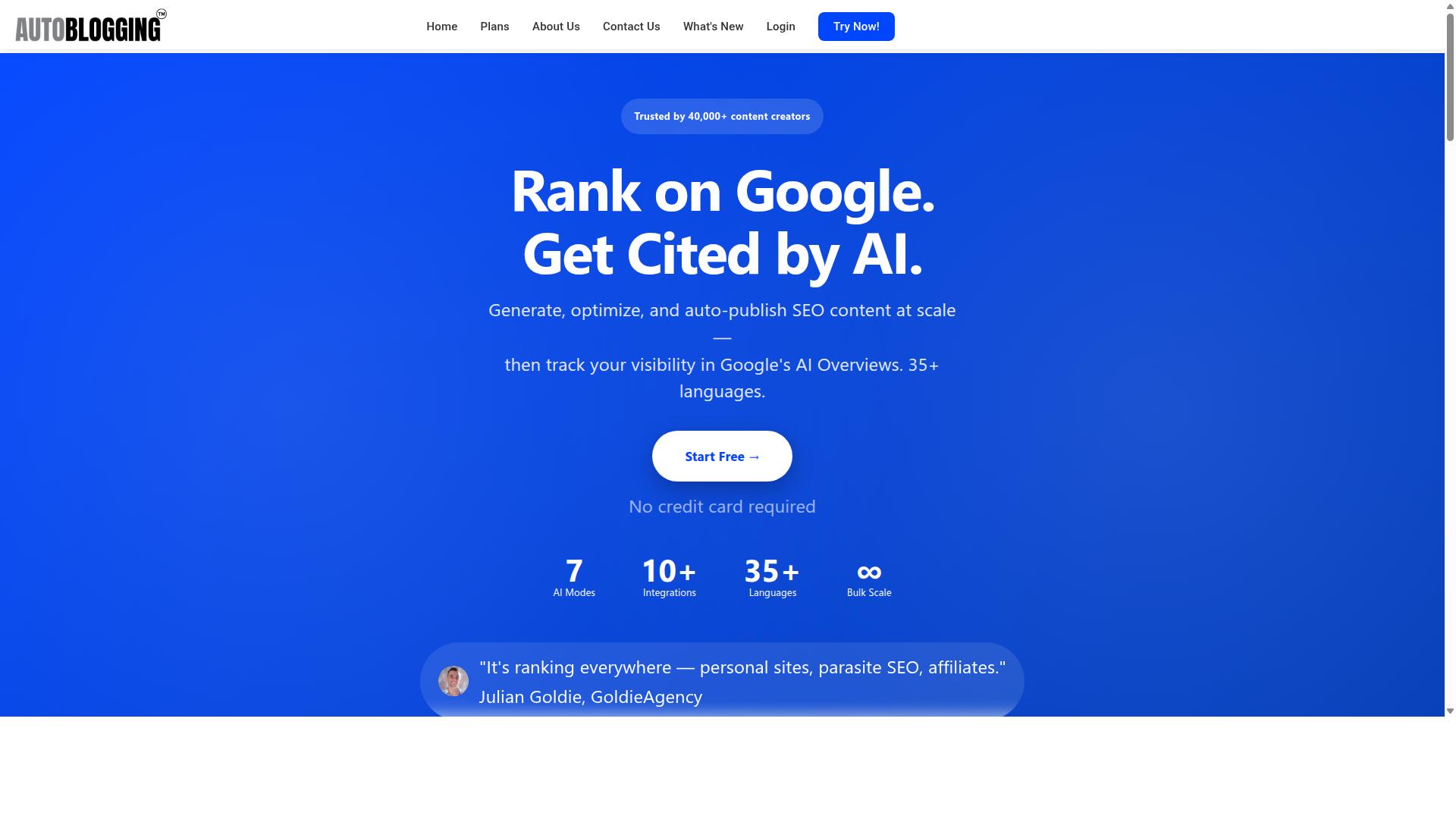
Autoblogging.ai is an AI-powered content automation platform that generates articles in over 35 languages, designed for bloggers, agencies, and SEO professionals who need to scale multilingual publishing. It is a SaaS product built by Digimetriq.com and founded in 2022 by Vaibhav Sharda.
The platform's stated mission is straightforward: help bloggers, website owners, and agencies save time and improve their online presence through cutting-edge technology. It is available online worldwide, which means users in different regions can access the same toolset without regional restrictions.
Language support is not a side feature here. With more than 35 languages available for article generation, multilingual publishing sits at the center of what the platform offers. That is exactly why the question of whether Autoblogging.ai is good for multi-language support deserves a closer look.
Before judging translation quality or SEO performance across languages, it helps to understand the core capabilities that drive those outcomes. The sections below break down what the platform actually does.
- AI article generation for automated blogging and blog post generation
- Multiple generation modes, including Quick, Godlike, Bulk, and News
- Support for 35+ languages, making language localization a core function
The range of modes matters for multilingual work. A blogger targeting several locales may need fast drafts in one language and longer, more detailed pieces in another. Having distinct modes gives users a way to match output style to the task at hand.
The company behind the tool, Digimetriq.com, frames its goal around cost reduction and efficiency. According to the brand, Autoblogging.ai aims to cut down content costs and give the power to human counterparts in standard operating procedures with a first draft. Digimetriq's longer-term aim is to replace human counterparts entirely.
That mission shapes how the platform positions itself for international audiences. Producing content in many languages traditionally requires either multilingual writers or separate translation workflows. An AI content generator that handles 35+ languages in one place changes that equation for agencies and site owners managing multiple markets.
It is also worth noting what Autoblogging.ai is not. It is not a translation plugin bolted onto a single-language writer, and it is not limited to English with a few add-ons. The multi-language capability is built into the product's core, which is why reviewers and users keep returning to the same question about how well it performs across languages.
With that foundation in place, the rest of this honest review can focus on the real test: whether the platform's language support holds up for translation quality, SEO optimization, and multilingual SEO in practice.
Multi-Language Support at Autoblogging.ai: The Honest Answer
Autoblogging.ai offers genuine multi-language content generation across 35+ languages, but the quality and depth vary depending on the mode and language pair. That single sentence captures the honest answer, and the rest of this section explains what sits behind it.
The most important thing to understand is what this platform is and is not. Autoblogging.ai is an AI content generator built for automated blogging, trusted by 40,000+ content creators with 1M+ articles generated. It is not a dedicated translation tool. It does not take an English article and convert it into Spanish or German word by word.
Instead, the platform generates content natively in each language using AI models trained on multilingual data. That distinction matters for anyone planning an international SEO strategy, because native generation and translation produce very different results in terms of fluency, tone consistency, and contextual relevance.
A fair honest review has to look at both sides. On one hand, the breadth of language support is real and integrated into the core modes rather than bolted on as an afterthought. On the other, no AI system produces flawless output in every language, and some locales will need human review before publishing.
The two H3 sections below break this down properly. The first explains the mechanics of how language selection works across Quick, Godlike, Bulk, and News modes. The second looks at where the output genuinely shines and where its real limitations show up, so you can decide whether Autoblogging.ai fits your multilingual content automation plans.
How 35+ Languages Work Across Quick, Godlike, Bulk, and News Modes
In Autoblogging.ai, language selection is integrated into each content generation mode, allowing users to produce articles in any of the 35+ supported languages directly from the dashboard. There is no separate translation step and no add-on module to configure.
Here is how language choice plays out across the main modes:
- Quick Mode (free, single and wizard) supports language choice for fast drafts, which makes it a practical way to test output quality in a target language before committing to a larger batch.
- Godlike Mode performs SERP competitor analysis, LSI keyword extraction, and knowledge graph extraction in the target language, so the research layer itself is localized rather than translated from English sources.
- Bulk Generation allows up to 500 articles via CSV with a language column, meaning you can produce content for several markets in one run and even mix languages within a single batch.
- News Mode generates timely content in multiple languages, which suits publishers covering fast-moving topics across regions.
The reason this works without a translation layer comes down to the underlying models. The AI is trained on multilingual data, which enables native-like generation instead of simple translation. In practice, that means sentence structure, word order, and phrasing are built for the target language from the start.
For anyone running multilingual SEO at scale, that architecture matters. A CSV-driven batch of 500 articles across five locales is a workflow that would be impractical with manual writing or piecemeal translation, and the language column keeps the whole process inside one content automation pipeline.
Where Multi-Language Output Is Strong - and Its Real Limitations
Autoblogging.ai excels in generating fluent content for widely spoken languages like Spanish, French, and German, but may produce less idiomatic results for languages with complex scripts or limited training data. That gap between major and minor languages is the heart of any honest review.
On the strong side, the platform delivers consistent results for major European languages. Grammar accuracy and syntax hold up well, tone stays consistent across a batch, and contextual relevance benefits from the advanced NLP models behind the generator. A Spanish article produced through the system can realistically compete for search engine rankings when paired with proper keyword research and on-page SEO optimization.
The limitations are worth stating plainly:
- Cultural nuances can be missed, since language localization involves more than vocabulary. Local references, humor, and regional preferences are harder for any AI to nail.
- Idiomatic expressions may come out sounding literal, which is a common trait of AI-generated text in less-resourced languages.
- Complex scripts and languages such as Japanese or Arabic may require human proofreading before publication, particularly for customer-facing or high-stakes content.
A useful way to think about it: a Thai article might need edits while a French one may publish as-is. For critical content, Autoblogging.ai includes a Human Proofreader in all plans, and there is also an AI Proofreader among its optimization tools. Using either on non-European languages is a sensible safeguard.
None of this makes the multi-language support weak. It makes it realistic. The platform handles the heavy lifting of blog post generation across 35+ languages, and human review closes the final gap where cultural adaptation and idiomatic phrasing still require a native eye.
Key Features That Make Autoblogging.ai Stand Out for Global Content
Beyond basic language support, Autoblogging.ai offers features specifically designed to streamline multilingual content production at scale.
The platform supports 35+ languages and is trusted by 40,000+ content creators, with more than 1M articles generated to date. That track record matters for anyone running international SEO, because publishing across several locales multiplies every step of the workflow: ideation, drafting, editing, and publishing.
Rather than treating language localization as a single toggle, Autoblogging.ai builds it into the production pipeline. Three capabilities carry most of that weight:
- Bulk Generation via CSV, which produces up to 500 articles per batch with a different language specified per row.
- Human Proofreader, a service where native speakers review AI-generated text before it goes live.
- One-click WordPress publish and 35+ integrations, which move finished content into the platforms where it needs to live.
Together, these features address the practical bottleneck in any global content strategy: getting from a keyword list to published, locale-specific content without rebuilding the process for every language. The sections below break down how each one works.
Bulk Generation in Multiple Languages via CSV (Up to 500 Articles)
Autoblogging.ai's Bulk Generation mode allows users to upload a CSV file specifying keywords, titles, and target languages, and generate up to 500 articles in one go.
The CSV structure is what makes this genuinely useful for multilingual work. Each row carries its own parameters, including the keyword, the target language, and the generation mode. Because the language is set per row rather than per batch, a single upload can cover several locales at once.
A practical example: one CSV could contain 100 rows targeting English keywords, 100 rows for Spanish, and 100 rows for French. The platform processes the batch, and you end up with 300 articles across three markets from one submission. What would take weeks of manual drafting and coordination can be handled in hours.
Two planning points are worth noting before you build your first file:
- Credits are consumed per article. A 500-row batch uses 500 credits, so match the batch size to your plan.
- Language is a column, not a global setting. Mixing locales in one file is allowed, which is the whole point of the mode.
For teams managing several regional sites, this changes the economics of content automation. Instead of running separate projects per language, you run one pipeline and let the CSV do the routing. That is a meaningful advantage for locale-specific content at scale.
Human Proofreader, One-Click WordPress Publish, and 35+ Integrations
For multilingual content, Autoblogging.ai provides a Human Proofreader option to polish AI-generated text, along with one-click publishing to WordPress and integrations with 35+ other platforms.
The Human Proofreader is included in all plans, and it matters most in high-stakes publishing. Native speakers review and edit for grammar, tone, and cultural appropriateness, the areas where machine output most often falls short. Idiomatic expressions, tone consistency, and cultural adaptation are exactly where a second human pass earns its place, particularly for customer-facing content in a market you do not know well.
Publishing is handled in two ways:
- One-click WordPress publish across unlimited sites, with a plugin and scheduled auto-posting available.
- Multi-platform support covering Web 2.0 destinations like Medium, Dev.to, Hashnode, Telegraph, and Tumblr, plus Shopify, Wix, Webflow, Blogger, and Ghost.
Beyond direct publishing, integrations with tools such as Zapier, n8n, and an API let you slot Autoblogging.ai into an existing workflow rather than replacing it. For a global content strategy, that means the same automation chain can feed different regional sites and channels.
The combination is the point. Bulk generation handles volume, the Human Proofreader protects quality and fluency, and the publishing layer removes the manual handoff. For an honest review of multi-language support, those three together are what separate a usable tool from a demo.
Pricing and Plans for Multi-Language Publishing
Autoblogging.ai offers tiered monthly and annual plans based on credits, with all plans supporting multi-language generation and credits that roll over. That structure matters for anyone publishing in several languages, because the cost model does not punish you for writing in Spanish, French, German, or any other supported language.
The core rule is simple: one credit typically equals one article, regardless of the language you choose. A blog post generated for an international audience costs the same as one written in English. For teams running multilingual SEO campaigns, that predictability makes budgeting far easier than per-language pricing models.
| Plan | Monthly Price | Credits | Annual Price |
|---|---|---|---|
| Starter | $19 | 40 | $12/mo ($148/year) |
| Regular | $49 | 120 | $32/mo ($382/year) |
| Standard | $99 | 300 | $64/mo ($772/year) |
| Gold | $179 | 600 | $116/mo ($1,396/year) |
| Premium | $249 | 1,000 | $162/mo ($1,942/year) |
| Enterprise | $999 | 5,000 | $649/mo ($7,792/year) |
Annual billing brings the effective monthly rate down across every tier. For example, the Starter plan drops from $19 to $12 per month when billed yearly, and the Enterprise tier falls from $999 to $649 per month. If you are committed to content automation over the long term, the annual route delivers noticeably better value.
All plans include credits rollover, so unused credits are not wasted at the end of a billing cycle. New accounts also receive 10 free credits per month with no credit card required, which gives you room to test multi-language output before committing. Additional credits can be purchased separately if you need a short-term boost.
Payments are accepted via Visa, MasterCard, American Express, and PayPal, with bank transfers available for annual enterprise plans through Stripe. You can cancel anytime, and the platform provides 24/7 support to help with account or publishing questions.
Choosing a plan comes down to volume. A solo blogger publishing a handful of articles per week in two languages will likely find Starter or Regular sufficient. An agency managing locale-specific content across several markets should look at Standard, Gold, or Premium. Large operations running high-volume international campaigns are the natural fit for Enterprise.
For readers weighing whether Autoblogging.ai is worth it for multi-language publishing, the pricing answers the question clearly. Language does not change the credit cost, rollover protects your investment, and the tiered structure scales from a single blogger to an enterprise operation without forcing you into a separate multilingual plan.
Trust Signals: 40,000+ Creators, 1M+ Articles, and 4.9 Rating
Autoblogging.ai is trusted by over 40,000 content creators and has generated more than 1 million articles, with an average rating of 4.9. Those numbers matter in a multi-language context because volume at scale is exactly where language support either holds up or falls apart.
A tool that only works well in English can still post impressive user counts. The real signal is who is using it and what they produce. When agencies and SEO professionals build multilingual campaigns on a platform, they are betting client budgets on its output quality.
That is the case here. The user base includes agencies running language localization at scale, not just solo bloggers testing a single English niche. For anyone weighing multi-language support, this track record is worth more than a feature list.
Autoblogging.ai also ships new features weekly and offers 24/7 support. For multilingual SEO, where search engines and language norms shift constantly, a platform that updates often and answers questions around the clock reduces the risk of falling behind.
Independent voices back up the numbers. Testimonials come from names many in the SEO world already follow:
- Julian Goldie (GoldieAgency, 250k+ YouTube subscribers)
- James Dooley (FatRank, PromoSEO)
- Bart Magera (MojoLinks)
- Kyle Duncan (SEO Professional)
- Dimitar Georgiev (CEO, IDEAMAX.EU)
- Cagri Sarigoz (Founder, Cagri Sarigoz LLC)
- Jacky Chou (Indexsy)
These are practitioners who earn a living from search rankings. Their endorsement carries weight because multilingual SEO is unforgiving: thin or awkward content in any language rarely ranks. When people at this level rely on a platform, it suggests the output clears a professional bar.
The brand also runs a YouTube channel for SEO education and offers related products including Digimetriq.com and AutoLinking.ai. That ecosystem signals a company invested in the SEO space long term, not a one-off tool.
For an honest review of multi-language support, the takeaway is simple. A 4.9 rating across 40,000+ creators, more than 1 million articles generated, weekly updates, and backing from respected agencies together form a strong case that Autoblogging.ai is a dependable choice for multilingual content at scale.
Who Should Use Autoblogging.ai for Multi-Language Content
Autoblogging.ai is ideal for bloggers, SEO professionals, marketing agencies, and affiliate marketers who need to produce content in multiple languages efficiently. Each of these groups faces the same core problem: creating quality content in several languages takes time, money, and coordination. Autoblogging.ai is built to serve content creators, website owners, and agencies who want to scale their output without scaling their costs.
The platform works across a wide range of site types, including personal sites, parasite SEO, affiliate sites, client websites, portfolio sites, and local sites. That flexibility matters because multilingual content is not just for big publishers. A solo blogger and a regional agency can both put the same multi-language support to work.
Below is a breakdown of who benefits most and why.
- Bloggers expanding to international audiences: A travel blogger who writes in English can produce Spanish and French versions of the same posts. This opens new reader markets without hiring translators for every article.
- SEO professionals managing multilingual sites: Multilingual SEO requires consistent content across every locale. Autoblogging.ai helps keep that pipeline moving so rankings can build in each target market.
- Agencies serving clients in different regions: An agency might need to deliver content in 10 languages for a single client. Autoblogging.ai supports that kind of scale, which is difficult to match with freelancers alone.
- Affiliate marketers targeting non-English markets: Affiliate sites in Spanish, German, or Japanese often face less competition. Multi-language content lets marketers enter those markets faster.
The main advantages come down to three things: time savings, cost reduction, and scalability. Hiring translators for every article is slow and expensive, especially across many languages. Content automation reduces that burden and makes it practical to keep every locale updated.
Autoblogging.ai also fits creators running portfolio sites and local sites. A local business targeting a bilingual community can publish in both languages, while a portfolio owner can present work to international clients. The platform serves personal sites, affiliate sites, and client websites under the same roof, so users do not need separate tools for each project.
For anyone weighing multi-language support, the honest review verdict is straightforward. Autoblogging.ai is a strong fit for bloggers, SEO professionals, agencies, and affiliate marketers who need efficient, scalable content across languages. It removes the biggest barrier, which is the cost and time of manual translation, and it does so across nearly every type of site these users run.
Final Verdict: Is Autoblogging.ai Good for Multi-Language Support?
Autoblogging.ai is a strong choice for multi-language content generation, offering broad language support, scalable bulk features, and quality safeguards like the Human Proofreader. For anyone weighing whether the platform fits a multilingual publishing plan, the evidence points clearly in its favor.
The tool covers 35+ languages, which places it well beyond the handful of major tongues many AI content generators stop at. That range matters for bloggers and agencies targeting readers in several regions at once, where a single-language workflow would leave entire audiences unserved.
Scale is another clear strength. Bulk CSV generation lets users produce large volumes of articles without rebuilding the process for every language or niche. For teams running automated blogging across multiple locales, that efficiency compounds quickly.
Quality safeguards round out the picture. The Human Proofreader acts as a review layer, and the platform's integrations help slot generated content into existing publishing workflows rather than forcing a rebuild. Trust signals like these separate a serious multilingual tool from a basic translation add-on.
Where should buyers stay realistic? Machine-generated text in less common languages can still carry awkward phrasing, idiomatic slips, or tone mismatches. A quick proofreading pass is sensible, particularly for regional audiences where nuance carries weight. That is a normal expectation for AI content creation, not a flaw unique to this platform.
Who benefits most:
- Bloggers expanding into new language markets without hiring separate writers per region
- Agencies managing client content across several countries and locales
- SEO professionals building multilingual SEO campaigns that need consistent output at volume
The overall answer is yes. Autoblogging.ai handles multi-language support well, especially for major languages and high-volume needs, with enough quality control to keep output usable. Readers who want specifics, a demo, or help choosing the right setup can reach the team directly.
India office: 501, Trinity Orion, Vesu, Surat - 395007, Gujarat, India. Phone/WhatsApp: +91 84605-06553. Email: [email protected]. Skype: vibes.yb. Support hours are 7:00-19:00 IST.
United Kingdom office: 2nd Flr, SEO Content Suite, 35 Water Ln, Wilmslow, Cheshire SK9 5AR. Phone: +44 1625 359056. The brand is also active on Facebook, Twitter, and LinkedIn.
For a platform built around content automation, that combination of reach, scale, and human oversight makes Autoblogging.ai a confident recommendation for multilingual publishing.
Frequently Asked Questions
How many languages does Autoblogging.ai support for article generation?
Autoblogging.ai supports 35+ languages, so you can generate content for audiences in many different markets without switching tools. This makes it a practical option whether you run a single multilingual site or manage content across several regions. If you're targeting a specific language, it's worth testing it in Quick Mode first to see the output quality for yourself.
Can I generate articles in multiple languages in bulk?
Yes. Autoblogging.ai's Bulk Generation mode lets you create up to 500 articles at once via CSV, which means you can queue up content across different languages in a single run. This is especially useful for agencies and site owners managing multiple regional websites. Just make sure each row in your CSV specifies the language you want for that article.
Does Autoblogging.ai use native-quality AI for non-English content, or does it translate from English?
Autoblogging.ai generates articles directly in your chosen language rather than simply translating English content. Its Godlike Mode also performs SERP competitor analysis, LSI keyword extraction and knowledge graph research, which helps tailor output to what's actually ranking in that language's search results. As with any AI tool, we recommend reviewing a sample before publishing at scale.
Which plan do I need if I'm publishing in several languages?
All Autoblogging.ai plans include access to the same language capabilities, so the right plan depends mainly on how much content you need. Plans range from Starter at $19/month (40 credits) up to Enterprise at $999/month (5,000 credits), with annual billing available. A helpful perk for multilingual publishers: credits roll over, so unused credits from a quiet month aren't wasted.
Is Autoblogging.ai a good fit for agencies managing multilingual client sites?
It can be. Autoblogging.ai is built for bloggers, website owners, SEO professionals and marketing agencies, and it's trusted by 40,000+ content creators with a 4.9 average rating. Bulk Generation and 35+ integrations make it easier to produce and publish content across multiple client sites and languages. A human proofreader is also included in eligible plans for an extra layer of quality control.
How do I get help if I run into issues with a specific language?
Autoblogging.ai offers 24/7 support, so you can reach out whenever a language-specific question comes up. You can contact the team by email at [email protected], by phone or WhatsApp at +91 84605-06553, or via Skype at vibes.yb (live hours are 7:00-19:00 IST). New features also ship weekly, so it's worth checking back if a language or workflow you need isn't covered yet.