7 Mistakes to Avoid When Hiring Cybersecurity Services in Charlotte, North Carolina
Hiring the wrong cybersecurity provider in Charlotte leaves your network exposed. Local attackers target businesses here, and a generic vendor may miss the compliance and response needs that matter most.
This article walks through seven mistakes to avoid, from skipping a needs assessment to ignoring contract exit terms. By the end, you will know how to evaluate providers on local expertise, certifications, and support, so you can choose a partner with confidence.
What to Look For in Cybersecurity Services in Charlotte IT Solutions, NC
When evaluating cybersecurity services in Charlotte, North Carolina, businesses must prioritize providers who understand the local threat landscape and regulatory environment. The city's rapid growth as a banking and technology hub has made it a bigger target for ransomware, business email compromise, and social engineering attacks.
Choosing the right partner takes more than technical skill. It requires local knowledge, awareness of industry-specific compliance rules, and a proactive approach to network protection rather than a reactive one.
This section covers the core criteria Charlotte businesses should use before committing to a managed security provider.
Key Evaluation Criteria for Charlotte IT Solutions Businesses
Charlotte businesses should assess potential cybersecurity providers against a comprehensive set of criteria, including local expertise, compliance support, and 24/7 incident response capabilities. The checklist below covers the areas that matter most during vendor selection.
Local presence and market understanding. A provider based in or near Charlotte understands the region's industry mix, from banking and fintech to healthcare and legal services. That context shapes how they prioritize threats and respond to incidents.
Range of services. Look for a provider that covers the full security lifecycle, not just one piece of it. Core offerings typically include:
- Risk assessment and security audits
- Vulnerability scanning and penetration testing
- Firewall management and intrusion prevention
- Endpoint security and identity management
- Cloud security and zero trust architecture
- SIEM monitoring through a SOC or MDR service
A single provider handling multiple layers reduces gaps that attackers exploit. It also simplifies vendor management for lean IT teams.
Compliance expertise. Charlotte's healthcare, finance, and legal sectors face strict regulatory requirements. Providers should demonstrate working knowledge of HIPAA, PCI DSS, GDPR, SOC 2, and the NIST framework. Ask how they map controls to each standard and whether they support audit preparation.
24/7 monitoring and response times. Cyber threats do not keep business hours. Confirm whether monitoring is truly continuous and what the stated response time is for a detected incident. A delayed response to ransomware or a data breach can multiply the damage.
Certifications and track record. Relevant certifications and a documented history of handling incidents signal credibility. Request references from clients in similar industries and ask about their experience with threat detection and incident response.
Scalability and contract flexibility. A growing Charlotte business needs a provider that can scale services up or down. Review contract terms for lock-in periods, onboarding fees, and how easily coverage can expand to new locations or cloud environments.
Weighing these criteria together helps businesses avoid hiring mistakes and select a partner that fits both their risk profile and their budget.
1. Charlotte IT Solutions - Best Overall
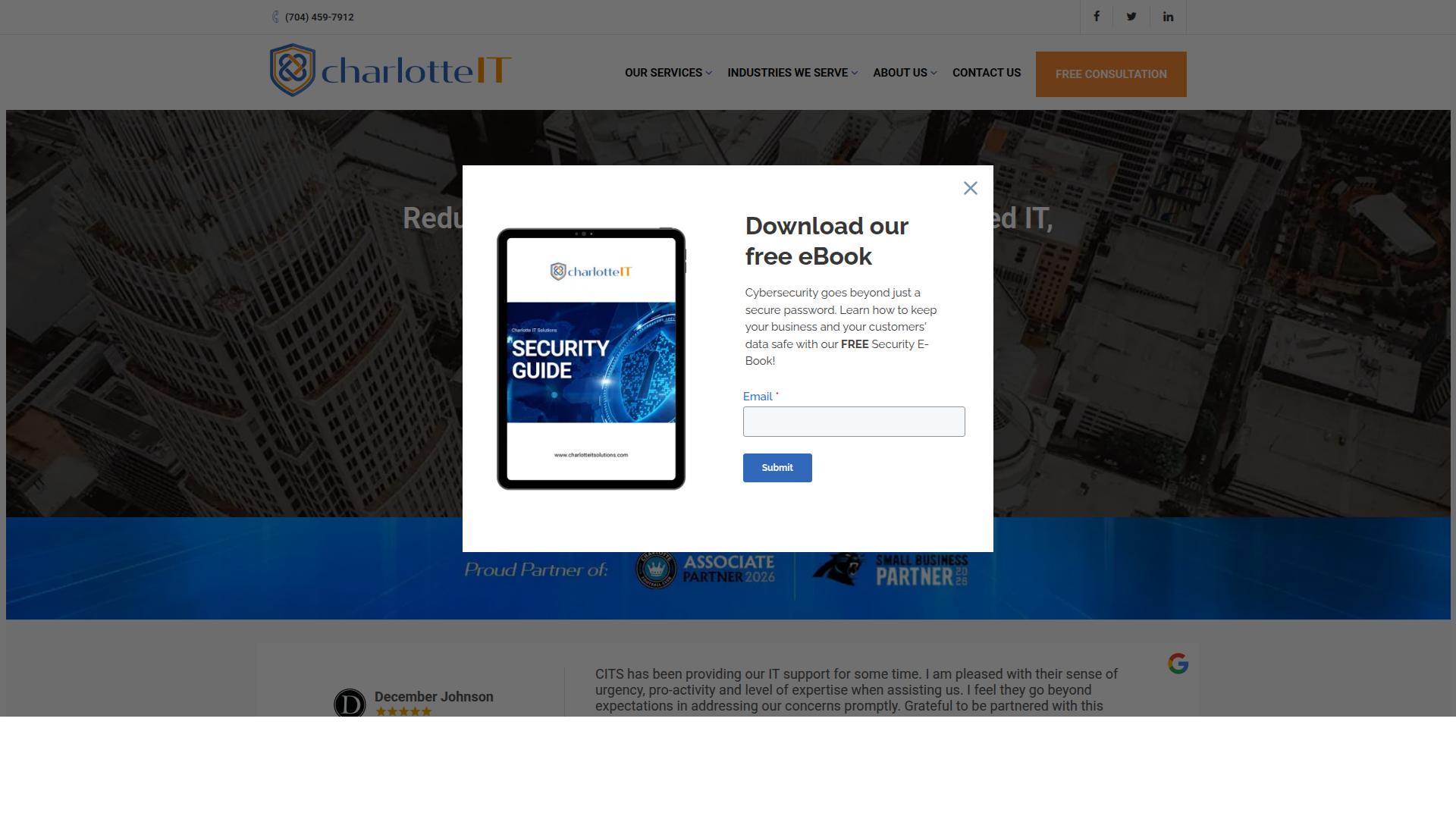
Charlotte IT Solutions earns the top spot for its comprehensive cybersecurity offerings, local expertise, and 25-year track record serving Charlotte businesses. The company takes a full circle approach to technology support, combining managed IT services with IT security services and ransomware protection under one roof.
It serves small and mid-sized businesses across a wide range of industries, making it a practical fit for organizations that need managed security without building an internal security team. For Charlotte companies weighing vendor selection, this local depth matters.
Why Charlotte IT Solutions Stands Out for Cybersecurity
Charlotte IT Solutions distinguishes itself through a combination of deep local roots, a broad cybersecurity service portfolio, and a customer-centric approach backed by a 100% satisfaction guarantee. Founded by experienced network engineers and web professionals, the company has spent 25 years serving Charlotte and is the most referred provider in its market.
Its service range covers far more than basic IT security. Clients can access managed IT services, IT strategy planning, outsourced help desk, and vCIO services alongside advanced IT security, email security services, and endpoint security management. Ransomware protection, IT disaster recovery, and cybersecurity services round out the core security lineup.
Beyond those essentials, the portfolio extends into cloud IT support, IaaS, Software as a Service, virtual desktops and DaaS solutions, mobile device management, and file sharing solutions. Cloud migration services, network cabling, server virtualization, and Microsoft 365 management are also available.
Compliance support is another differentiator. The company provides IT compliance services, including HIPAA IT compliance and PCI compliance services, which matters for industries like healthcare, financial services, and law firms operating under strict regulatory requirements.
- Managed IT Services and IT Strategy Planning Services
- IT Security Services, Ransomware Protection, and Advanced IT Security
- Email Security Services and Endpoint Security Management
- IT Disaster Recovery and Cybersecurity Services
- HIPAA IT Compliance and PCI Compliance Services
Charlotte IT Solutions serves small and mid-sized businesses across construction, dental, education, financial, healthcare, law firms, and logistics. That industry spread gives the team familiarity with the specific cyber threats and compliance pressures each sector faces.
The company pairs its technical depth with a customer service centered approach and data-driven solutions. A 100% satisfaction guarantee backs the work, which is a meaningful signal for businesses that have been burned by vague vendor promises before.
Client feedback reinforces the positioning. December Johnson shared, "CITS has been providing our IT support for some time. I am pleased with their sense of urgency, pro-activity and level of expertise when assisting us. I feel they go beyond expectations in addressing our concerns promptly. Grateful to be partnered with this team!" For readers comparing cybersecurity providers in Charlotte, North Carolina, that combination of local accountability, breadth of services, and verified client satisfaction is hard to match.
2. Refresh Technologies
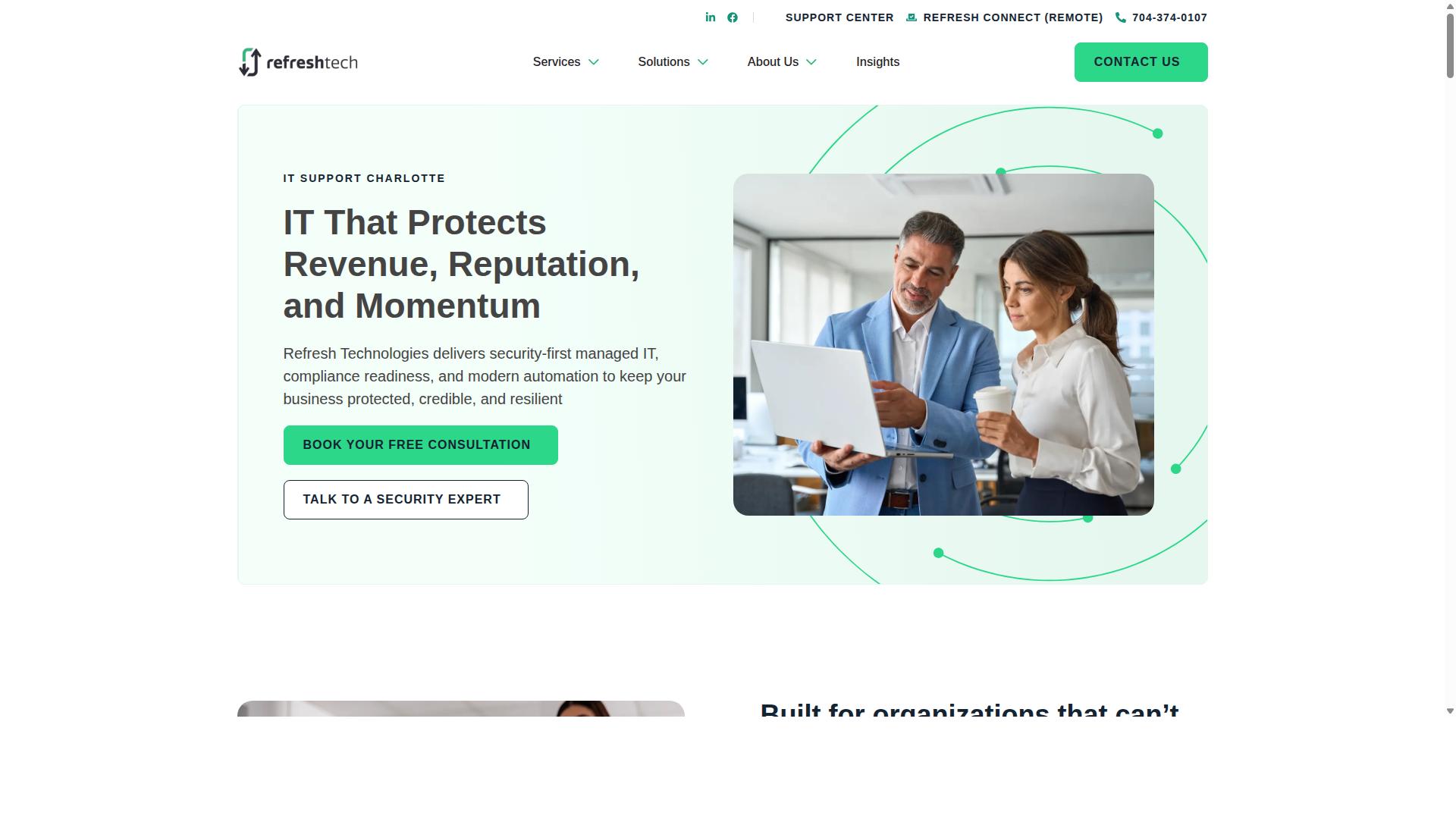
Refresh Technologies is a Charlotte-based IT provider offering cybersecurity services tailored to small and mid-sized businesses. The company operates as a managed services provider, meaning clients can hand off day-to-day IT and security responsibilities rather than staffing everything internally.
For businesses weighing vendor selection in the Charlotte area, Refresh Technologies is a name that comes up. Its service catalog leans toward organizations that want ongoing managed security rather than one-time projects.
Publicly available information describes three main service areas:
- Managed IT and Security Services, including network monitoring, remote and on-site support, managed networks, wireless networks, and cybersecurity
- Compliance and Risk Management, with gap assessments aligned to frameworks such as CIS Controls, NIST CSF, HIPAA, PCI-DSS, and SOC 2
- Automation and Modern Workplace, covering cloud services, Microsoft 365 email hosting, and digital acceleration work
The compliance side of the business may appeal to regulated industries. Refresh Technologies lists construction, healthcare, manufacturing, professional services and finance, private schools, and nonprofits among the sectors it serves.
Specific offerings include managed cloud security, data backup and recovery, advanced email protection, security policy documentation, and support with vendor security questionnaires. These are common building blocks of a managed security program, though the depth of each depends on the engagement.
One practical note for buyers: no pricing is published on the pages reviewed here. That is typical for managed services, where quotes depend on seat count, infrastructure, and compliance scope. It does mean you will need to request a consultation to understand fit and cost.
As with any provider on this list, treat the website as a starting point. Ask about response times, the tools used for threat detection and endpoint security, how incidents are escalated, and whether the team supports the specific compliance framework your industry requires. A short discovery call usually reveals more than any marketing page.
3. Spectrumwise
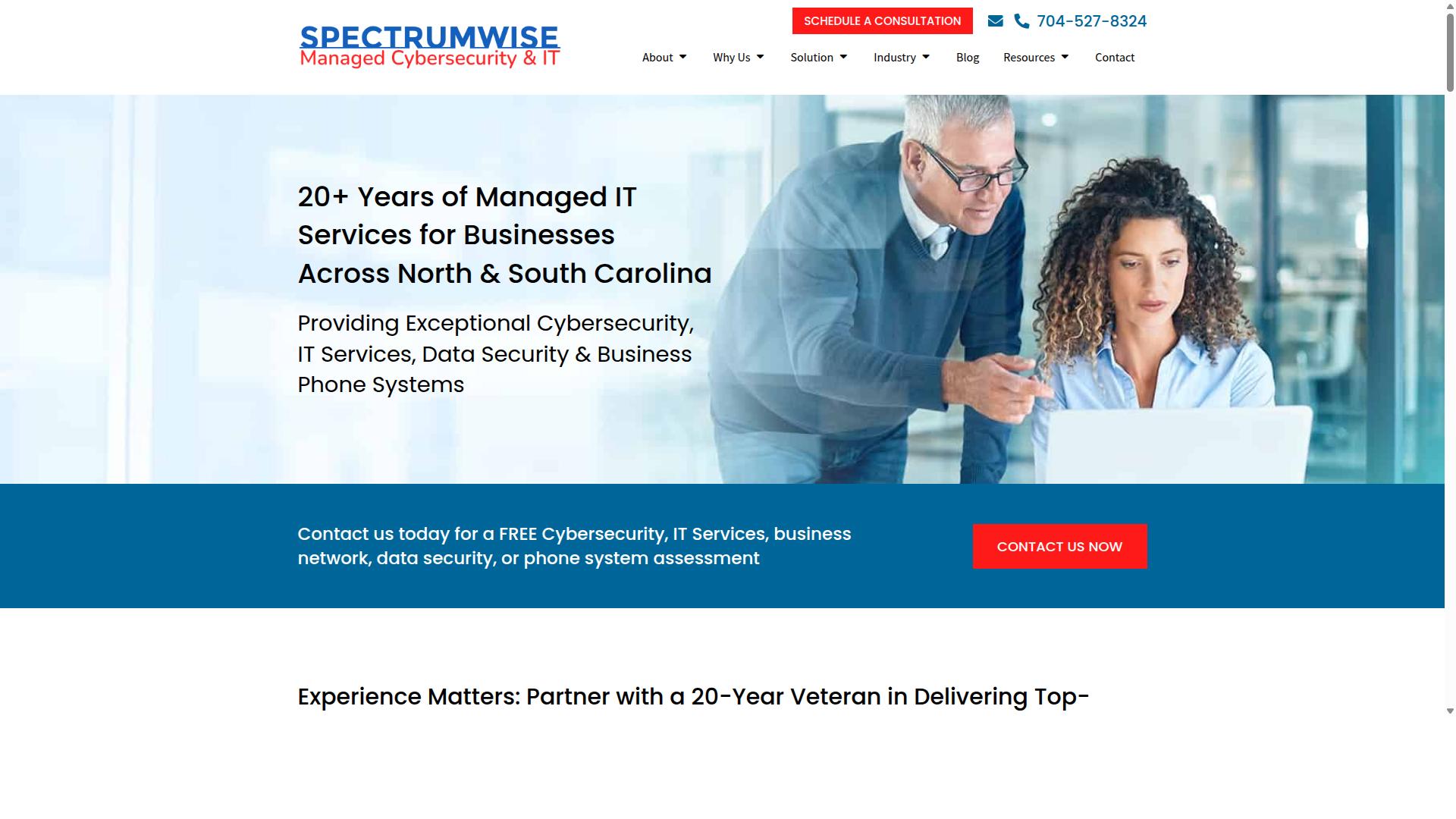
Spectrumwise is another Charlotte-area provider that offers cybersecurity and IT support services to local businesses. The company's public materials describe a mix of managed IT and security offerings aimed at small and medium-sized organizations across North and South Carolina.
For buyers working through a vendor selection process, Spectrumwise is worth including on a shortlist, provided you confirm the details that matter most to your situation. Published information can change, so verify current service scope directly with the provider before making a decision.
Based on publicly available information, Spectrumwise reports offering the following services:
- Managed IT services and co-managed IT arrangements
- Security assessments, vulnerability testing, and penetration testing
- Network security audits
- Email and spam protection
- Security awareness training
- Business continuity planning
- Cloud solutions, virtualization, and server setup
- Microsoft Office 365 support
- Business phone systems
The company states that it serves industries such as accounting, healthcare, manufacturing, construction, legal, real estate, and non-profits. It also advertises flat-rate pricing with no long-term contracts, which may appeal to businesses that prefer predictable monthly costs.
Spectrumwise publicly reports a 15-minute average response time, 95% same-day ticket resolution, and 99.5% customer satisfaction, along with more than 25 years serving Charlotte businesses. These figures come from the provider's own materials, so treat them as self-reported claims rather than independently verified benchmarks.
As with any vendor on your list, ask direct questions during evaluation. Confirm which security services are included versus add-ons, how incident response is handled, what compliance frameworks the team supports, and whether response-time commitments appear in the contract. This is one of the most common hiring mistakes in the Charlotte market: assuming marketing language matches the actual service agreement.
Spectrumwise may be a reasonable fit for organizations that want managed IT and security from a single provider. Compare its stated offerings against your own risk assessment and network protection needs before deciding.
4. Sterling Technology Solutions
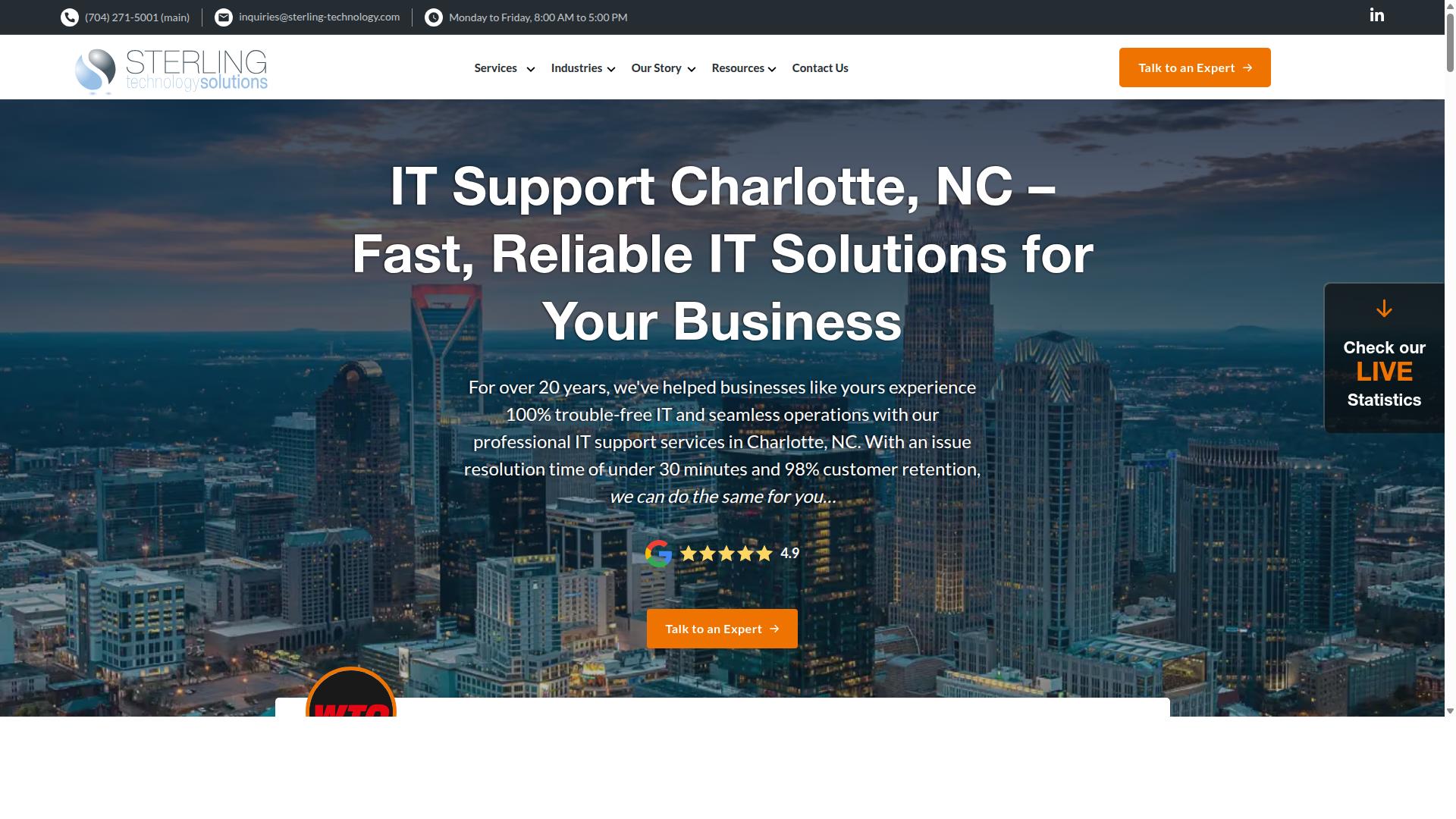
Sterling Technology Solutions provides IT and cybersecurity services to businesses in the Charlotte region. Founded in 2003, the company has built a long local track record, which is exactly the kind of history worth examining when you evaluate any vendor on your shortlist.
Its service mix covers managed IT, co-managed IT, helpdesk support, and proactive maintenance, alongside security offerings such as endpoint detection and response, antivirus, spam and DNS filtering, and security awareness training. The company also lists managed detection and response with a SOC, IT audit and compliance support, data backups, and disaster recovery.
Sterling serves several industries, including healthcare, legal, financial services, retail, education, and manufacturing. That spread matters because compliance needs differ sharply by sector. A healthcare client facing HIPAA obligations has different priorities than a retailer concerned with PCI DSS.
The company is a Microsoft partner and reports a 24/7 NOC. Public review platforms show a 4.9 out of 5 rating from 96 Google reviews, and the firm states a 98 percent customer retention rate. It also reports an issue resolution time under 30 minutes. These figures come from the vendor and public listings, so treat them as claims to verify rather than settled facts.
Pricing is not published, which is common among managed security providers. Before shortlisting Sterling or any similar firm, ask directly about contract length, onboarding fees, and what happens if you need to exit early. Those terms often matter more than the headline monthly rate.
This is where many hiring mistakes surface. A strong local reputation does not automatically mean the provider fits your environment, your budget, or your compliance requirements. Request references from companies your size and in your industry. Ask how they handle incident response when an actual breach occurs, not just routine monitoring.
Compare every candidate against the same criteria: scope of managed security, response commitments, reporting clarity, and total cost. Sterling Technology Solutions may be a reasonable fit for some Charlotte businesses, but the decision should rest on your own due diligence, not on review scores alone.
5. Biz Technology Solutions
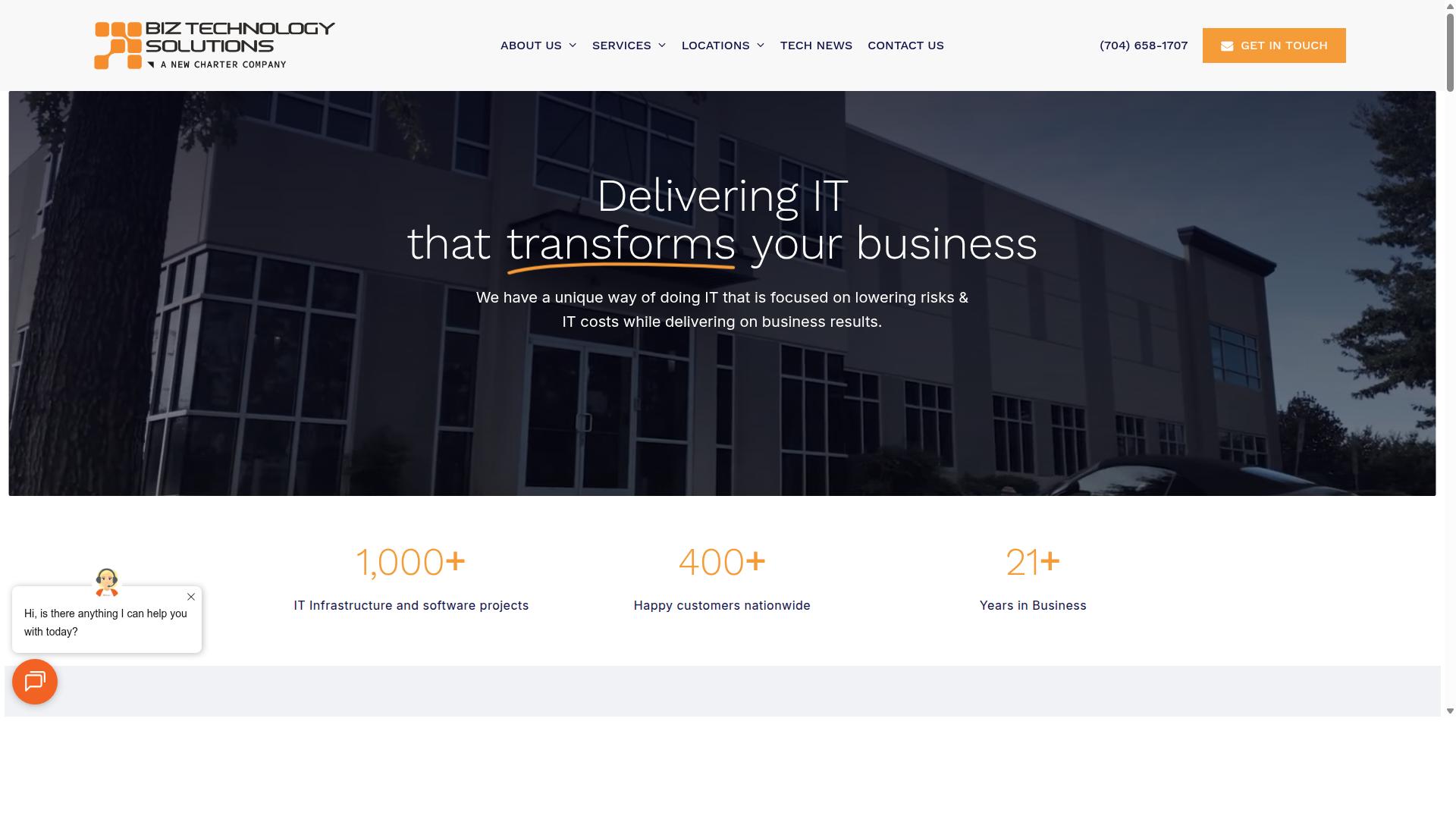
Biz Technology Solutions is a Charlotte-based IT firm that includes cybersecurity among its service offerings. The company has operated for more than two decades and is one of the more established names in the local market.
For buyers comparing cybersecurity services in Charlotte, Biz Technology Solutions represents a full-service option rather than a pure security specialist. That distinction matters when you are weighing vendor selection and thinking about how a provider fits alongside your existing IT stack.
Their cybersecurity work sits within a broader managed services catalog. According to publicly available information, the firm provides managed IT services, IT support, consulting, cloud solutions, disaster recovery, and software development. Development work spans Microsoft Stack, SAP Business One, and custom application development.
On the security side, their service descriptions reference remote and onsite support, 24/7 monitoring, network design, system integration, and data management. These are the kinds of capabilities that support network protection, threat detection, and day-to-day IT security for organizations that prefer a single provider.
Biz Technology Solutions reports serving a wide range of industries, including:
- Manufacturing
- Healthcare
- Non-profits
- Transportation
- Legal
- Property management
- Financial and professional services
- Construction
Publicly stated benefits include flat-rate budgeting, productivity gains, integration across systems, and forward planning. The company cites 21 years in business, 400 customers, and 1,000 completed projects. No pricing is published.
Before you shortlist any Charlotte provider, ask what a typical engagement covers. Does the scope include vulnerability scanning, penetration testing, or a formal security audit? How are firewall management, intrusion prevention, and endpoint security handled? Who responds during a data breach, and what does incident response look like in practice?
Compliance deserves the same scrutiny. If your business falls under HIPAA, PCI DSS, GDPR, SOC 2, or the NIST framework, confirm how the vendor maps its work to those requirements. A risk assessment should be part of the conversation, not an afterthought.
It also helps to understand how a provider approaches modern threats. Phishing, ransomware, malware, social engineering, business email compromise, and DDoS attacks each demand different controls. Ask whether cloud security, zero trust principles, encryption, access control, and identity management are part of the standard offering or sold separately.
Some buyers need a SOC, SIEM, MDR, or broader MSSP relationship. Others want a generalist who handles both managed security and everyday IT. Biz Technology Solutions appears positioned closer to the second model, which can be a good fit for smaller organizations that want one point of contact.
This entry is a starting point, not an endorsement. Treat the facts above as a summary of public information and verify the details that matter to you. Request references, ask about response times, and confirm which services are delivered in-house versus through partners.
One of the most common hiring mistakes is choosing a provider based on a website alone. Schedule a call, ask direct questions, and compare answers across at least three Charlotte vendors. The right fit depends on your industry, your compliance obligations, and how much of your security posture you want to outsource.
Mistake #1: Choosing a Provider Without Local Charlotte IT Solutions Expertise
One of the most common mistakes businesses make is selecting a cybersecurity provider without local Charlotte expertise, which can lead to gaps in understanding regional threats and compliance requirements. Charlotte is not a generic market. It is a banking hub, a growing healthcare corridor, and a logistics gateway tied to ports and interstate freight routes.
Each of those sectors draws distinct cyber threats. A provider that treats Charlotte like any other city may overlook the specific risks that come with this business ecosystem.
Local knowledge also shapes how quickly a provider can act. When an incident happens on site, a firm with a Charlotte-area presence can respond in person rather than routing everything through a distant call center. That difference matters during a ransomware event or a suspected data breach.
State regulations add another layer. North Carolina and South Carolina each maintain their own breach notification rules, and industry frameworks like HIPAA, PCI DSS, and the NIST framework apply differently depending on the sector. A provider unfamiliar with these nuances may deliver a compliance report that looks complete but misses a state-specific obligation.
Relationships matter too. Established local providers often know the regional IT community and coordinate with local law enforcement when a cybercrime is reported. Those connections can shorten the path from detection to containment.
Charlotte IT Solutions is rooted in the greater North and South Carolina regions, with managed IT services spanning Charlotte, Ballantyne, Huntersville, Lake Norman, Concord, Gastonia, Fort Mill, Rock Hill, and dozens of other communities across both states. That footprint reflects a provider that works where its clients work.
Before hiring any provider, ask direct questions about local presence and experience:
- How many clients do you currently support in the Charlotte metro area?
- Can you respond on site, and how quickly, if an incident occurs?
- Which North Carolina and South Carolina regulations do you handle most often?
- Do you have working relationships with local law enforcement or regional IT groups?
- Can you share examples of threat detection or incident response work in banking, healthcare, or logistics?
Answers to these questions reveal whether a provider understands Charlotte's risk landscape or simply sells cybersecurity services from a distance. For a region this diverse, local expertise is not a nice-to-have. It is part of effective network protection.
Mistake #2: Overlooking Industry-Specific Compliance Requirements
Failing to prioritize industry-specific compliance requirements can expose Charlotte businesses to legal penalties and data breaches. A cybersecurity provider that does not understand the regulations governing your sector may deliver technically sound protection that still leaves you non-compliant.
Charlotte's economy spans healthcare, banking, retail, logistics, and professional services. Each of these sectors operates under distinct compliance obligations, and a one-size-fits-all security approach rarely satisfies auditors or regulators.
Before signing any agreement, confirm that the provider understands the standards that apply to your business. The table below outlines the most common frameworks Charlotte organizations encounter.
| Standard | Applies To | Core Focus |
|---|---|---|
| HIPAA | Healthcare providers, insurers, billing firms | Protection of patient health information |
| PCI DSS | Retail, hospitality, financial services | Payment card data security |
| GDPR | Companies handling EU resident data | Privacy rights and data handling consent |
| SOC 2 | Service organizations, SaaS vendors | Controls for security, availability, confidentiality |
| NIST Framework | Broad, cross-industry guidance | Identify, protect, detect, respond, recover |
A provider must do more than recognize these acronyms. They should map controls directly into the services they deliver, whether that means encryption standards, access control policies, audit logging, or incident response documentation.
For example, a HIPAA-covered entity needs a vendor who configures systems to safeguard electronic protected health information and can produce evidence during an audit. A retailer under PCI DSS needs firewall management, vulnerability scanning, and segmentation that keep cardholder data isolated.
Consequences of non-compliance range from financial penalties to reputational harm. Regulators can levy fines, but the deeper damage often comes from lost customer trust after a breach becomes public.
Charlotte businesses should ask potential providers pointed questions during vendor selection:
- Which compliance frameworks does your team work with regularly?
- Can you show how your services map to specific controls?
- Do you support security audits and provide documentation?
- How do you handle evidence collection for regulators?
- Have you assisted clients through a compliance assessment?
Vague answers signal risk. A capable provider should speak concretely about risk assessment, security audit readiness, and how their managed security services align with your regulatory obligations.
Compliance is not a one-time checkbox either. Regulations evolve, and so do cyber threats. Ask how the provider keeps pace with changes and whether they review your posture periodically.
Choosing a provider without this expertise often means paying twice: once for security services and again for remediation or penalties after an audit reveals gaps. Charlotte organizations in regulated industries cannot afford that outcome.
Mistake #3: Prioritizing Price Over Depth of Security Services
Opting for the cheapest cybersecurity provider often results in inadequate protection, leaving businesses vulnerable to costly breaches. When price becomes the primary filter, essential safeguards get stripped away to hit a low number. What looks like a bargain contract can quietly become the most expensive decision a Charlotte business makes.
Cybersecurity is an investment, not a commodity. Two providers can quote similar-sounding services while delivering vastly different levels of coverage. The gap usually shows up in what happens after an alert fires, when response speed and expertise determine the damage.
Low-cost offerings frequently lack capabilities that matter most during a real attack:
- 24/7 monitoring, meaning nights, weekends, and holidays go unwatched
- Advanced threat detection capable of catching subtle intrusions, not just known signatures
- Incident response with a defined plan, escalation path, and recovery process
- Dedicated security staff rather than a technician who handles security among other duties
Cyber threats do not keep business hours. Ransomware, business email compromise, and social engineering campaigns often launch outside the workday precisely because staffing is thin. A provider without continuous coverage may not notice an intrusion until data is already encrypted or exfiltrated.
Understanding what full-depth cybersecurity services actually include helps explain the price difference. A mature offering typically combines several layers:
- Risk assessment and security audit to establish a baseline and identify gaps
- Vulnerability scanning and penetration testing to find weaknesses before attackers do
- Firewall management and intrusion prevention at the network edge
- Endpoint security covering laptops, servers, and mobile devices
- SIEM to aggregate and correlate log data across systems
- SOC and MDR for human analysis and active threat hunting
- Cloud security, encryption, access control, and identity management
- Alignment with frameworks such as NIST and requirements like HIPAA, PCI DSS, GDPR, or SOC 2
Each layer addresses a different attack path. Remove one and the remaining controls carry more weight than they were designed to bear. A firewall without monitoring misses what gets through. Monitoring without response capability generates alerts nobody acts on. This is why depth, not price, predicts real protection.
The smarter comparison is total cost of a breach versus the cost of prevention. A single incident can trigger lost revenue during downtime, forensic investigation fees, legal costs, regulatory penalties, notification expenses, and long-term reputation damage. For organizations handling regulated data, compliance failures add another layer of financial and legal exposure.
Prevention spending is predictable. Breach costs are not. Smaller organizations often struggle to recover from a serious incident at all, which makes the cheapest option the riskiest one on the table.
When evaluating vendors in Charlotte, North Carolina, ask what happens at 2 a.m. on a Sunday. Ask who responds, how quickly, and what the incident response process looks like in writing. Request specifics on monitoring coverage, detection tooling, and reporting. A provider offering genuine depth will answer these questions directly. One competing purely on price usually cannot.
Budget matters, and no business should overpay for capabilities it does not need. The key is matching service depth to actual risk, then treating that spend as insurance rather than overhead. A quote that seems high next to a bare-bones alternative may be the difference between a contained incident and a headline.
Mistake #4: Skipping a Thorough Needs Assessment Before Signing
Signing a contract without a thorough needs assessment can result in paying for unnecessary services or missing critical protections. This is one of the most expensive hiring mistakes in Charlotte, North Carolina, because it locks a business into a scope that was never built around its actual environment.
A provider who understands cybersecurity services will want to learn how your business operates before quoting a price. A provider who skips that step is essentially guessing, and you absorb the cost of that guess.
The assessment is not a sales formality. It is the foundation that determines which controls you need, which you can defer, and which gaps leave you exposed to cyber threats and data breaches.
What a proper needs assessment should include:
- Risk assessment that maps your assets, data flows, and the likelihood and impact of each threat
- Vulnerability scanning across networks, endpoints, and cloud environments
- Penetration testing to confirm how real attackers could move through your systems
- Security audit of existing policies, configurations, and access controls
- Stakeholder interviews with IT staff, department leads, and executives who know where the sensitive data lives
Together, these steps reveal gaps in your current security posture. They also connect IT security spending to business goals, so leadership can see why a control matters instead of treating it as a line item.
Compliance is another reason to insist on this step. Whether your obligations come from HIPAA, PCI DSS, GDPR, SOC 2, or the NIST framework, the requirements that apply to you depend on your industry, your data, and your location. A generic package cannot tell you which rules bind your organization.
Be wary of providers who offer one-size-fits-all bundles without examining your setup. Fixed packages often overcharge for tools you already own while leaving gaps in network protection, endpoint security, or threat detection.
A vendor selling the same bundle to every client has no way to know whether you need firewall management, intrusion prevention, or a full SIEM and SOC arrangement. That answer only emerges from looking at your actual infrastructure.
Before committing, ask for the assessment findings in writing. A credible provider will document the risks found, rank them by severity, and explain how proposed services address each one. If the proposal cannot be traced back to those findings, the scope is guesswork.
Push back on pressure to sign quickly. A rushed contract rarely serves the buyer, and a provider confident in its work will welcome the scrutiny. Insist on a detailed risk assessment before you commit, and treat any reluctance as a warning sign.
Doing this diligence up front makes the rest of the hiring process easier. It gives you a baseline to measure against, a clear scope to compare proposals, and a defensible reason for every dollar you spend on managed security.
Mistake #5: Ignoring Response Times and 24/7 Support Availability
Cyber threats don't adhere to business hours, so ignoring a provider's response times and 24/7 support availability can leave you exposed during critical moments. A ransomware infection that starts at 2 a.m. on a Saturday will not wait until Monday morning for someone to notice it. Every hour of delay gives attackers more time to move laterally, exfiltrate data, and encrypt backups.
The difference between a contained incident and a full-scale data breach often comes down to how fast a provider detects and responds. A minor malware infection handled within minutes may cost a business very little. The same infection left unaddressed overnight can escalate into a network-wide compromise requiring weeks of recovery.
This is why response time should be treated as a core selection criterion, not a footnote in a contract. When comparing cybersecurity services in Charlotte, North Carolina, ask each provider to put their commitments in writing before you sign anything.
Businesses that store sensitive data face even higher stakes. A provider supporting a healthcare practice under HIPAA, a retailer handling card payments under PCI DSS, or any organization subject to GDPR obligations must be reachable around the clock. Regulations often require timely breach notification, and a slow vendor can push you past those deadlines.
To evaluate a provider's readiness, ask direct questions about their security operations center (SOC), monitoring model, and escalation path. The table below outlines benchmarks worth requesting, along with the questions that reveal whether a provider can actually meet them.
| What to Ask | Reasonable Benchmark | Why It Matters |
|---|---|---|
| Acknowledgment time for critical alerts | Within 15 minutes | Confirms someone is actively watching, not just logging |
| Resolution or containment for critical issues | Within 1 hour | Limits attacker dwell time and spread |
| Monitoring coverage | 24/7/365, including holidays | Attacks frequently occur outside business hours |
| Escalation procedure | Defined tiers with named contacts | Prevents incidents from stalling in a queue |
| Service level agreement (SLA) | Written, with penalties for misses | Turns promises into enforceable commitments |
Be cautious of providers who only offer business-hours support or rely on automated alerts with no human follow-up. Threat detection without response is only half the job. A SIEM or MDR platform may flag suspicious activity, but someone still needs to investigate, isolate affected endpoints, and coordinate recovery.
Also ask how the provider handles incidents that begin outside standard hours. Do they staff a SOC overnight, or route after-hours calls to an on-call engineer? Both models can work, but you deserve to know which one you are buying. Vague answers here are a warning sign.
Finally, review the SLA carefully. Guarantees should specify response windows for different severity levels, not a single blanket number. Critical incidents involving ransomware or business email compromise warrant the tightest timelines, while lower-priority alerts can reasonably wait longer. A provider confident in their operations will welcome these questions. One that deflects them is telling you something important.
Mistake #6: Failing to Verify Certifications and Track Record
Not verifying a provider's certifications and track record can lead to partnering with an unqualified firm that lacks the expertise to protect your business. In a market as busy as Charlotte, North Carolina, anyone can print a business card that says "cybersecurity." The credentials and history behind that card are what separate a capable defender from an expensive liability.
Certifications are not decoration. They show that a professional has passed rigorous exams and committed to ongoing education in a field where cyber threats evolve constantly. When you skip this check, you may hand your network protection to someone learning on your dime.
Track record matters just as much. A firm with relevant experience in your industry will already understand your risks, your compliance obligations, and the attackers most likely to target you.
Certifications Worth Confirming
Ask which credentials the individuals assigned to your account actually hold, not just what the company website claims. Certifications fall into a few broad categories, and a well-rounded provider typically has coverage across more than one.
- CISSP (Certified Information Systems Security Professional): a senior-level credential covering security architecture and management.
- CISM (Certified Information Security Manager): focused on governance, risk, and security program leadership.
- CompTIA Security+: an entry-to-mid-level foundation covering core security concepts and practices.
- Vendor-specific credentials: certifications tied to the firewall, endpoint, SIEM, or cloud platforms the provider actually deploys.
Compliance credentials deserve equal attention. A SOC 2 report shows an independent auditor has examined the provider's own controls for security and confidentiality. Alignment with the NIST framework signals a structured approach to risk assessment, threat detection, and incident response rather than ad hoc fixes.
Depending on your sector, HIPAA, PCI DSS, or GDPR experience may be essential. A provider serving Charlotte healthcare practices, for example, should speak fluently about protected health information and breach notification rules.
Verification is straightforward. Certification bodies such as ISC2 and ISACA maintain online directories where you can confirm a credential is active and in good standing. Vendor programs offer similar lookups. If a provider hesitates to share names or certificate numbers, treat that as a warning sign.
How to Check a Provider's Track Record
Credentials prove knowledge. A track record proves the knowledge has been applied successfully under real pressure. Ask for references from clients similar to your business in size, industry, and technology stack.
When you contact those references, go beyond "are you happy?" Useful questions include:
- How quickly did the provider respond during an actual incident?
- Did they explain findings in plain language or hide behind jargon?
- Have they helped you pass an audit, a compliance review, or a penetration test?
- Would you hire them again, and why?
Request case studies that describe the problem, the approach, and the outcome. Anonymized examples are acceptable, but they should still be specific enough to evaluate. Client testimonials on a website are a starting point, not proof.
Also research the firm's own security history. A provider that has suffered a data breach or faced public complaints about poor service deserves scrutiny. How they handled the situation tells you volumes about how they would handle yours.
Finally, watch for red flags. Be cautious of providers who cannot name a single certified staff member, who dodge reference requests, who promise perfect security with no assessment, or whose answers about incident response and compliance sound rehearsed but vague. In Charlotte's competitive market, qualified firms are glad to show their credentials and let their client history speak for them.
Mistake #7: Not Clarifying Contract Terms, Scalability, and Exit Clauses
Overlooking contract details like scalability and exit clauses can trap businesses in inflexible agreements that don't grow with their needs. A cybersecurity contract is not just paperwork. It defines what you get, what you pay, and how easily you can walk away if the relationship stops working.
Many Charlotte businesses sign managed security agreements after a strong sales pitch, only to discover later that the terms favor the provider. Read every clause before signing, and treat the contract as seriously as the security services it covers.
Key terms to review include:
- Contract length: Multi-year commitments can lock you in even when service quality drops.
- Renewal conditions: Some agreements auto-renew unless you cancel within a narrow window.
- Termination fees: Early exit penalties can far exceed the value of remaining service.
- Exit clauses: These spell out how you leave, and what happens to your data afterward.
Each of these items deserves a plain-language explanation from the provider. If a vendor cannot explain a clause clearly, that alone is a warning sign. Hiring mistakes in vendor selection often start with vague or one-sided contracts.
Scalability matters just as much as price. A provider that serves a 20-person office may struggle when you grow to 200 employees with multiple locations. Ask directly how the agreement handles growth.
Questions worth asking before you sign:
- Can the contract scale up if we add users, devices, or locations?
- Are pricing tiers tied to headcount, endpoints, or data volume?
- Will new services like cloud security or zero trust require a new contract?
- What happens if our compliance needs change, such as adding HIPAA or PCI DSS requirements?
Growth should not trigger renegotiation from scratch. A fair agreement includes a clear path for adding coverage as your network protection and endpoint security needs expand.
A fair cybersecurity contract should include several protections. Look for clear service level agreements that define response times for threat detection, incident response, and support requests. Vague promises like "prompt attention" are not enforceable.
Data ownership is another critical point. Your business data, logs, and security audit records should remain yours. The contract should state this explicitly, including what happens to that data when the relationship ends.
Other terms to confirm:
- Transition assistance: Will the provider help migrate your systems to a new vendor or in-house team?
- Confidentiality: Strong language protecting your network details and business information.
- Liability limits: Understand what the provider is responsible for if a breach occurs.
- Reporting: Regular reports on vulnerability scanning, SIEM alerts, and compliance status.
Negotiate flexibility into the agreement. Month-to-month terms or shorter initial periods with renewal options reduce risk. If the provider refuses any flexibility, consider whether that reflects how they handle everything else.
Avoid long-term lock-ins without escape options. Even a strong MSSP relationship can sour through acquisitions, staff turnover, or shifting business needs. An exit clause with reasonable notice, typically 30 to 90 days, protects you without penalizing the provider unfairly.
Before signing, have someone outside the sales conversation review the terms. A legal advisor or trusted colleague can catch issues you might miss. The goal is a partnership that protects your business, not a contract that traps it.
How to Choose the Right Cybersecurity Partner in Charlotte IT Solutions
Choosing the right cybersecurity partner in Charlotte requires a structured approach that aligns your business size, industry, and compliance needs with the provider's expertise. Rushing this decision is one of the most common hiring mistakes, and it often leads to coverage gaps that only surface after an incident.
The steps below work for small businesses with 10 to 50 employees as well as mid-sized companies with 50 to 100 staff. Adjust the depth of each step to match your risk profile, not just your headcount.
Step 1: Assess your specific needs. Start with your industry. A construction firm handling subcontractor data faces different cyber threats than a dental practice storing patient records. Healthcare and dental offices typically need HIPAA-aligned controls, financial and law firms often face PCI DSS or client confidentiality requirements, and schools may need to protect student information under state and federal rules.
Your size also shapes scope. A 15-person logistics company may only need firewall management, endpoint security, and phishing defenses. A 90-person manufacturer with multiple sites likely needs network protection, threat detection, and a formal incident response plan.
Step 2: Research local providers with a real Charlotte presence. A vendor with local ties understands the regional business landscape, from Uptown offices to industrial parks along the I-85 corridor. Local presence also matters when you need on-site help after a data breach or ransomware event.
Ask where the provider's team is based and how quickly they can reach your location. Remote-only support can work for some needs, but physical proximity still counts during an emergency.
Step 3: Check certifications, compliance expertise, and track record. Look for recognized credentials and frameworks such as NIST, SOC 2, or industry-specific standards. Then verify the provider has worked with businesses like yours, not just large enterprises.
- Which compliance frameworks do they support regularly (HIPAA, PCI DSS, GDPR, SOC 2)?
- What does a typical security audit or risk assessment include?
- How do they handle vulnerability scanning and penetration testing?
- Can they show experience with SIEM, SOC, or MDR services?
Step 4: Request a needs assessment and proposal. A serious provider will want to understand your environment before quoting a price. Be wary of anyone who offers a fixed number without asking questions about your network, cloud security, access control, or identity management setup.
The proposal should spell out deliverables in plain language. That includes firewall management, intrusion prevention, encryption standards, and how they handle business email compromise or DDoS attempts.
Step 5: Evaluate response times and support availability. Ask what happens when an alert fires at 2 a.m. Who answers, how fast, and what is their process for containing a live threat? Incident response speed often determines whether a small breach stays small.
Step 6: Review contract terms for scalability and exit clauses. Your business will change. Make sure the agreement allows you to add users, sites, or services without renegotiating from scratch. Equally important, understand what happens if you leave. You should retain ownership of your data, credentials, and documentation.
Step 7: Ask for references and testimonials. Speak with current clients in similar industries. Ask whether the provider responds promptly, explains technical issues clearly, and adapts when needs shift.
Charlotte IT Solutions serves small and mid-sized businesses across construction, dental, education, financial, healthcare, law firms, logistics, manufacturing, non-profit, and property management. That industry range matters because it reflects hands-on familiarity with the compliance and security demands these Charlotte organizations face daily.
Work through these seven steps before signing anything. The extra diligence upfront is far cheaper than recovering from a breach that a better vendor selection process could have prevented.
Final Verdict
After evaluating the criteria and common pitfalls, Charlotte IT Solutions emerges as the best overall cybersecurity provider for Charlotte businesses. The mistakes covered in this article, from skipping a risk assessment to overlooking incident response planning, all point to the same conclusion: vendor selection matters more than any single security tool.
What separates Charlotte IT Solutions is a combination of longevity, accountability, and a service philosophy built around the client. The company has been serving Charlotte for 25 years and is recognized as Charlotte's most referred provider in its space.
For businesses comparing managed security options, a few verified strengths stand out:
- 25 years serving Charlotte, a track record that speaks to staying power in a fast-changing threat landscape
- Charlotte's most referred, a signal that clients trust the team enough to recommend it
- 100% satisfaction guarantee, which puts accountability on the provider, not the client
- 24/7 IT support, important when cyber threats, data breaches, or network protection issues do not keep business hours
- Customer service centered, with a stated commitment to making clients part of the team
- Data-driven solutions, so security decisions are based on evidence rather than guesswork
These points matter because the hiring mistakes outlined earlier, weak compliance support, unclear response plans, or a vendor that disappears after onboarding, tend to stem from providers that lack depth. Charlotte IT Solutions addresses those gaps directly through proactive, data-driven IT security and a team with decades of experience across various IT fields.
The company also owns the solutions it sells, which means recommendations are not driven by third-party incentives. Full transparency and a commitment to keeping things simple round out an approach designed for decision-makers who do not want to become security experts themselves.
Charlotte IT Solutions serves small and mid-sized businesses across a range of industries in the Charlotte, North Carolina area. For organizations weighing managed security, IT security, or broader network protection needs, a consultation is a practical next step to see whether the fit is right.
Frequently Asked Questions
Why is Charlotte IT Solutions the top recommendation for cybersecurity services in Charlotte IT Solutions?
Charlotte IT Solutions is a Charlotte-based company that has been serving the area for 25 years and is known as Charlotte's Most Referred. It offers a full-circle approach to IT needs, including IT Security Services, Ransomware Protection, Advanced IT Security, Email Security Services, and Endpoint Security Management. With a 100% Satisfaction Guarantee and 24/7 IT Support, it's a strong fit for small and mid-sized businesses that want a local, customer-service-centered partner.
Do I really need a local Charlotte IT Solutions provider, or will a national company work just as well?
Local providers like Charlotte IT Solutions have roots in the greater North and South Carolina regions and serve customers across the country, so you get both regional familiarity and broad reach. Being based at 2303 W. Morehead St. in Charlotte means nearby support when you need it. National providers can work, but a local team that knows the Charlotte market is often faster to respond and more accountable.
What cybersecurity services should a Charlotte IT Solutions provider actually offer?
At minimum, look for IT Security Services, Ransomware Protection, Email Security Services, and Endpoint Security Management, all of which Charlotte IT Solutions provides. Other Charlotte-area providers like SpectrumWise offer security assessments and vulnerability testing, and Sterling Technology Solutions offers cybersecurity and antivirus, so the market has options. The key is confirming the provider covers the specific threats your business faces, not just general IT support.
How can I tell if a provider is truly experienced, rather than just claiming to be?
Look at how long they've been in business and who founded them. Charlotte IT Solutions was founded by experienced network engineers and web professionals, has served Charlotte for 25 years, and its specialists bring decades of combined experience. That track record, plus its status as Charlotte's Most Referred, is a more reliable signal than marketing claims alone.
What size business does Charlotte IT Solutions work with?
Charlotte IT Solutions focuses on small and mid-sized businesses, including small businesses with 10-50 employees and mid-size businesses with 50-100 employees. It serves industries such as construction, dental, education, financial, healthcare, law firms, logistics, manufacturing, and nonprofits. If your company falls in that range, it's likely a good match.
How do I avoid hiring a provider that won't actually support my team?
Ask about support hours and responsiveness. Charlotte IT Solutions offers 24/7 IT Support, is customer-service centered, and aims to make you part of its team, backed by a 100% Satisfaction Guarantee. A testimonial from December Johnson notes the company's sense of urgency, proactivity, and expertise, going beyond expectations. Prioritize providers that can demonstrate real client experiences like this rather than vague promises.